Understanding Florida Lien Waivers: Risks, Rules, and Best Practices
Florida lien waivers can affect your right to file a construction lien. Learn what contractors must know about lien waivers, risks to avoid, and how to protect payment rights.
.png)
Last updated:
March 17th, 2026
Published:
March 17, 2026
3 mins
Read
In Florida construction projects, paperwork often determines whether you get paid as much as the work itself. Contractors, subcontractors, and suppliers frequently sign lien waivers during the payment process, sometimes without realizing the legal consequences.
A lien waiver can be a routine document, but it can also remove one of the strongest tools construction professionals have to secure payment: the right to file a construction lien. We at SunRay have spent nearly two decades helping contractors protect their lien and bond claim rights. Through working with thousands of construction professionals across the country, we have seen firsthand how small mistakes with lien waivers can create major payment problems. Understanding how lien waivers work in Florida and how to use them properly can make the difference between protecting your payment rights and accidentally giving them away.
What Is a Lien Waiver?
A lien waiver is a document in which a contractor, subcontractor, or supplier agrees to give up their right to file a mechanic’s lien against a property.
In most cases, lien waivers are exchanged in return for payment. Owners, lenders, and general contractors request them as proof that payments have been made and that the property will remain free of liens. However, signing a lien waiver means you may be releasing your lien rights, which is why these documents must always be reviewed carefully.
.jpg)
Why Lien Waivers Matter on Florida Construction Projects
When contractors and suppliers do not receive payment for their work, Florida construction law grants them strong lien rights. A construction lien can attach to the property itself and create powerful leverage for payment. But a lien waiver can remove that protection.
In many projects, owners and general contractors require lien waivers before releasing progress payments. While this helps keep projects moving forward without payment disputes, contractors must ensure that the waiver accurately reflects the payment being made. A waiver signed too early or with overly broad language could eliminate lien rights even if the contractor has not been fully paid.
The Types of Lien Waivers Used in Florida
Lien waivers generally fall into two main categories: conditional and unconditional. The difference between them can significantly affect payment rights.
1. Conditional Lien Waivers
A conditional lien waiver only becomes effective once payment has actually been received.
For example, a subcontractor may sign a conditional waiver stating that lien rights are waived only upon receipt of payment for a specific amount or billing period.
This type of waiver provides protection because if the payment does not arrive or the check fails to clear, the lien rights remain intact.
For most contractors, conditional waivers are the safer option when exchanging documentation during the payment process.
2. Unconditional Lien Waivers
An unconditional lien waiver immediately waives lien rights regardless of whether payment has been received.
Once signed, the contractor has essentially confirmed that payment has been made and that no lien rights remain for the work covered in the waiver.
Because of this, unconditional waivers should generally only be signed after the payment has been received and verified. Signing one too early can make recovering unpaid amounts much more difficult.
Florida’s Statutory Lien Waiver Forms
Florida construction law includes statutory lien waiver forms under Chapter 713 of the Florida Statutes.
These standardized forms were created to reduce confusion and disputes in the construction payment process. They typically include information such as:
- The contractor or supplier signing the waiver
- The owner or paying party
- The project description
- The payment amount being acknowledged
- The timeframe of work covered by the waiver
While the statutory forms provide structure, contractors should still review any waiver carefully. Some documents may include modified language that expands the scope of what is being waived.
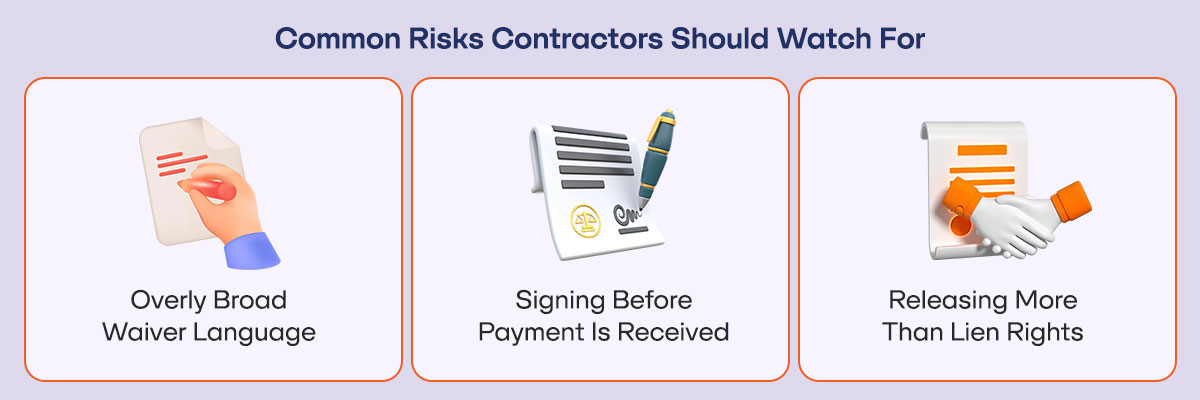
Common Risks Contractors Should Watch For
Through her work with contractors nationwide, Ariela Wagner has seen several common issues arise when lien waivers are used incorrectly.
1. Overly Broad Waiver Language
Some lien waivers attempt to release rights for future work or unpaid amounts. Contractors should ensure that the waiver clearly references the specific payment amount and billing period it applies to.
2. Signing Before Payment Is Received
One of the most frequent mistakes occurs when contractors sign unconditional waivers before the payment has cleared.
This can eliminate lien rights even if the payment is delayed, disputed, or never received.
3. Releasing More Than Lien Rights
Certain lien waivers may include additional language that releases other claims, such as:
- Change order disputes
- Delay claims
- Contractual claims beyond the payment amount
Before signing, contractors should confirm that the waiver only addresses the lien rights associated with the payment being made.
Best Practices When Handling Lien Waivers in Florida
Graphic - Best Practices When Handling Lien Waivers in Florida – Mention the 4 points from below
.jpg)
Contractors can avoid many payment issues by following a few simple practices when dealing with lien waivers.
1. Review Every Waiver Carefully
Even if a waiver appears routine, contractors should confirm that it includes:
- The correct payment amount
- The correct project information
- The appropriate time period for the work covered
- No additional claim releases beyond lien rights
2. Match the Waiver to the Payment
The waiver should correspond exactly to the payment received. If the payment covers work performed through a certain date or billing cycle, the waiver should reflect that timeframe.
3. Use Conditional Waivers Whenever Possible
Conditional waivers provide an additional layer of protection until payment is confirmed. Whenever possible, contractors should request conditional waivers rather than unconditional ones.
4. Maintain Clear Documentation
Keeping organized records of every lien waiver signed during a project can help prevent confusion about which payments have been covered. Clear documentation also helps contractors protect their rights if a payment dispute arises later.
How Lien Waivers Fit Into Florida’s Payment Protection Process
Lien waivers are only one part of Florida’s broader construction payment protection system. Contractors often use them alongside other documents, such as:
- Progress payment applications
- Partial releases of lien
- Final releases after project completion
When these documents are used properly, they create a clear record of payment throughout the project. However, missing deadlines or signing the wrong document can weaken a contractor’s ability to enforce payment rights.
Key Takeaways for Florida Contractors
- Lien waivers are commonly used in Florida construction projects to confirm payment and prevent liens.
- Signing a lien waiver may eliminate your right to file a construction lien.
- Conditional waivers protect contractors until payment is actually received.
- Unconditional waivers should only be signed after payment has cleared.
- Contractors should carefully review waiver language to avoid releasing additional claims.
- Organized documentation helps protect payment rights throughout the project.
Protect Your Lien Rights Before Signing Anything
Many contractors only realize the impact of a lien waiver after a payment issue occurs. By then, it may be too late to recover lost lien rights. Today, SunRay helps process and protect millions of construction notices and payment rights every year across the United States.
Need help protecting your lien rights?
✔ Send construction notices correctly
✔ Track lien deadlines
✔ Avoid costly documentation mistakes
.jpg)
Frequently Asked Questions About Florida Lien Waivers
What is a lien waiver in Florida construction?
A lien waiver is a document where a contractor, subcontractor, or supplier agrees to waive their right to file a construction lien, usually in exchange for payment.
Are lien waivers required under Florida law?
Florida law does not require lien waivers, but they are widely used on construction projects as part of the payment process.
What is the difference between a conditional and unconditional lien waiver?
A conditional waiver only becomes effective once payment has been received, while an unconditional waiver immediately eliminates lien rights regardless of payment status.
Can a contractor refuse to sign a lien waiver?
Yes. However, owners or general contractors may delay payment until the waiver is provided. Contractors should ensure that the waiver matches the payment being made.
Do lien waivers replace the Notice to Owner in Florida?
No. Serving a Notice to Owner (NTO) within the required deadline is still necessary to preserve lien rights on most Florida construction projects.
FAQs: Fundamentals of Lien Laws

Ariela C. Wagner

.jpg)
.png)