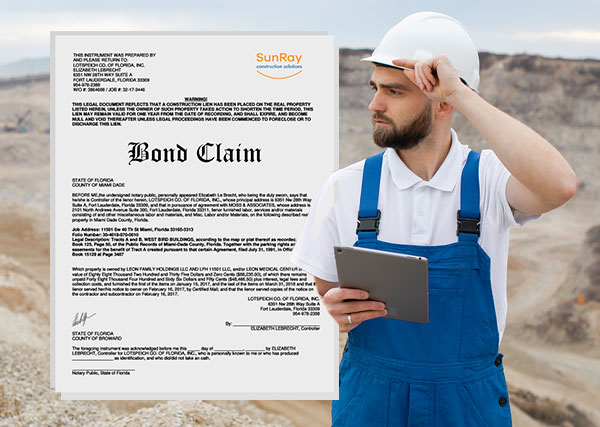
Bond to Indemnify Against Lien in Texas: A Practical Guide
Learn how a Bond to Indemnify Against Lien in Texas allows a property owner or contractor to remove a mechanic’s lien from the property while preserving the claimant’s right to pursue payment through a bonded claim.
.png)
Last updated:
February 5th, 2026
Published:
December 30, 2025
5 mins
Read
When a mechanic’s lien is filed in Texas, it can immediately cloud title and disrupt financing, sales, or project closeout. This practical guide explains how a Bond to Indemnify Against Lien works, when it is used, and what it means for owners, contractors, and lien claimants.
At SunRay, we work with contractors, subcontractors, suppliers, and property owners across Texas every day. One issue that consistently causes confusion, and costly mistakes, is the Bond to Indemnify Against Lien.
This is not a technical loophole or a way to make a lien “disappear.” It is a statutory mechanism that shifts risk, changes leverage and alters how payment disputes are enforced. Understanding how it truly works under Texas law is critical if you want to protect your rights or your property.
What Is a Bond to Indemnify Against Lien?
A Bond to Indemnify Against Lien, often called a lien indemnity bond or bonding around a lien, is a surety bond that replaces a recorded mechanic’s lien with a financial guarantee.
Once properly recorded, the lien no longer attaches to the real property. Instead, it attaches to the bond.
From our perspective at SunRay, the key takeaway is this: the lien is removed from the property, but the debt claim is not eliminated.
Why Owners and Contractors Use This Bond
.jpg)
In Texas, a recorded lien can immediately create business problems, even before a dispute is resolved. We most often see lien indemnity bonds used for three practical reasons:
1. Clearing Title to the Property
A lien clouds title and can stop refinancing, sales, or permanent financing. Bonding around the lien restores marketable title while the dispute continues elsewhere.
2. Maintaining Project and Business Momentum
Owners and general contractors often need to keep projects moving or close transactions. The bond removes the lien leverage tied directly to the property.
3. Containing Risk
Instead of risking foreclosure against real estate, the dispute is transferred to a bond backed by a surety company.
Who Can File a Bond to Indemnify Against Lien in Texas?
Under Texas law, the bond may generally be filed by:
- The property owner
- The original contractor or general contractor
- Any party with a legal interest in the property subject to the lien
The bond must be issued by a licensed surety authorized to do business in Texas and recorded in the same county where the lien was filed.
How the Process Works in Practice
.jpg)
Based on thousands of projects we have tracked, the real-world process typically looks like this:
Step 1 - A Mechanic’s Lien Is Filed
A contractor, subcontractor, or supplier records a lien in the county property records.
Step 2 - The Bond Is Obtained
The owner or contractor works with a surety to secure a bond that meets statutory requirements.
Step 3 - The Bond Is Recorded
The bond is recorded with the county clerk where the lien was originally filed.
Step 4 - The Lien Is Discharged From the Property
Once recorded correctly, the lien is removed from the property and attaches to the bond.
Step 5 - The Claimant Must Enforce Against the Bond
Any lawsuit to recover payment must now be brought against the bond, not the property.
Bond Amount Requirements: Where Mistakes Happen
One of the most common errors we see is posting an insufficient bond.
In Texas, the bond amount must exceed the lien amount and is designed to cover:
- The full claimed lien amount
- Interest
- Court costs
- Potential attorneys’ fees
If the bond does not meet statutory requirements, the claimant may challenge it, and the lien may not be properly discharged. This is not a technicality. It is a frequent and expensive oversight.

What a Bonded Lien Means for Lien Claimants
For subcontractors and suppliers, bonding around a lien changes the strategy but not the underlying right to payment.
Key Implications
- You cannot foreclose on the property
Your claim is now limited to the bond.
- Deadlines do not reset
Enforcement deadlines continue to apply. Missing the lawsuit deadline can permanently extinguish your claim.
- Sureties are not owners
Surety companies scrutinize documentation, notices, and compliance far more aggressively than most property owners.
From SunRay’s experience, bonded lien claims fail far more often due to procedural errors than because the debt is invalid.
Advantages and Trade-Offs
For Owners and Contractors
Advantages
- Immediate removal of lien from the property
- Protection of financing and sale timelines
- Reduced property-level risk
Trade-Offs
- Bond premiums and underwriting requirements
- The payment dispute still exists
- Litigation may become more formal and technical
For Claimants
Advantages
- A financially backed surety stands behind the bond
- Property ownership disputes are removed from the equation
Risks
- Strict enforcement deadlines
- Higher documentation standards
- No leverage through foreclosure
Common Misconceptions We See at SunRay
“Bonding off the lien makes the problem go away.”
It does not. It simply changes where the fight happens.
“Once a bond is filed, payment is guaranteed.”
False. Claimants must still prove compliance with Texas lien law and contract terms.
“The bond gives me more time to act.”
Incorrect. Deadlines remain unforgiving and unchanged.
Why Deadline Tracking Matters More After a Bond Is Filed
In our work managing lien and bond claim workflows nationwide, one pattern is consistent:
bonded lien claims are lost because deadlines are missed.
Once a lien is bonded off, there is often a false sense of security. Claimants assume the surety will “sort it out later.” In reality, the burden shifts entirely to timely enforcement and perfect documentation. This is where professional deadline tracking and compliance systems become essential, not optional.
Final Thoughts
A Bond to Indemnify Against Lien is a powerful tool under Texas law, but it is also a double-edged sword. It protects property owners from encumbrances while preserving lien claimants’ rights through a bonded claim.
Whether you are bonding around a lien or enforcing one, success depends on strict compliance, accurate documentation, and disciplined deadline management. At SunRay Construction Solutions, we see firsthand that precision, not pressure, is what ultimately gets parties paid.
FAQs
1. Does a Bond to Indemnify Against Lien eliminate the mechanic’s lien entirely?
No. The bond removes the lien from the property's records, but it does not eliminate the underlying payment claim. Once the bond is recorded, the lien attaches to the bond instead of the real property, and the claimant must pursue payment against the bond.
2. Who is allowed to file a Bond to Indemnify Against Lien in Texas?
In Texas, the bond may be filed by the property owner, the original contractor, or any party with a legal interest in the property. The bond must be issued by a licensed Texas surety and recorded in the same county where the lien was originally filed.
3. How much does a Bond to Indemnify Against Lien have to be?
The bond amount must exceed the lien amount and is designed to cover the full claim plus potential interest, court costs, and attorneys’ fees. If the bond amount does not meet statutory requirements, it can be challenged and may fail to properly discharge the lien.
4. What happens to lien enforcement deadlines after a lien is bonded off?
Lien enforcement deadlines do not reset or extend. Once a lien is bonded off, the claimant must still file suit within the applicable statutory enforcement period. Missing this deadline can permanently extinguish the claim, even if the bond is valid.
5. Is a bonded lien easier or harder to enforce than a standard mechanic’s lien?
It is typically more procedural. While the property is no longer at risk, surety companies closely scrutinize compliance with notice requirements, lien validity, and documentation. From our experience, bonded lien claims most often fail due to missed deadlines or technical noncompliance, not because the debt is invalid.
FAQs: Fundamentals of Lien Laws

Ariela C. Wagner