
I Recorded my Lien, Now What - How Do I Get Paid - Florida
Learn what happens after recording a Florida construction lien, how long your lien lasts, how to get paid, and what to do if it is contested or bonded off.
.png)
Last updated:
September 22nd, 2026
Published:
Aug 31, 2026
5-8 mins
Read
I Recorded a Florida Construction Lien—Now What? How to Enforce It and Get Paid
Recording a Florida construction lien is an important step toward protecting your right to payment—but it does not automatically get you paid.
Once the lien is recorded, it becomes the claimant's responsibility to pursue payment, monitor the enforcement deadline, respond to any documents that shorten that deadline, and decide whether a lien foreclosure lawsuit is necessary.
This guide explains what happens after recording a Florida construction lien, how long the lien remains effective, what it means when a lien is bonded off, and what to do if you receive a Notice of Contest of Lien or a 20-day summons.
Important: This article provides general educational information and is not legal advice. Florida lien requirements and enforcement options depend on the project, contracts, parties, notices, and specific circumstances. Consult a qualified Florida construction attorney regarding a particular claim.
What Is a Florida Construction Lien?
A Florida construction lien is an encumbrance against privately owned real property for the value of qualifying labor, services, or materials provided to improve the property.
The lien creates a cloud on the property's title. In many ways, it functions like a mortgage because it attaches a payment claim to the property itself.
A recorded lien may:
- Affect the owner's ability to sell the property
- Interfere with refinancing
- Create issues with a construction loan
- Cause a technical default under the owner's mortgage
- Create a contractual default for a general contractor or subcontractor
- Increase pressure on the parties responsible for payment
Many mortgages and construction contracts require the property to remain free of liens. As a result, recording a lien can bring the owner, contractor, lender, and other interested parties into the payment dispute.
What Happens After You Record a Florida Construction Lien?
Immediately after recording the lien, nothing automatically happens.
No government agency collects the money for you. The court does not automatically open a case, and the property is not automatically scheduled for sale.
The lien remains in the public records and creates an encumbrance against the property. It may be enough to motivate the owner, contractor, or lender to resolve the debt, but payment is not guaranteed.
Unless the lien creates enough pressure to produce payment or the lien is transferred to a bond, the claimant must decide what additional collection and enforcement steps to take.
Recording the lien starts the process. It does not finish it.
Why Is It Still Important to Record a Lien?
Although a lien does not automatically produce payment, contractors and suppliers who properly preserve lien rights are generally in a stronger position than those who do not.
If a project has limited funds available, parties with valid lien or bond rights may receive attention before unsecured creditors.
A lien also gives the claimant a potential right to file a civil lawsuit seeking:
- A determination that the lien is valid
- A judgment for the amount owed
- Foreclosure of the lien
- Sale of the property, subject to other interests
- Recovery of available property equity
- Attorney fees when allowed by law
- Related contractual or equitable remedies
The lien is therefore both a collection tool and a potential source of security for the unpaid balance.
How Long Is a Florida Construction Lien Valid?
A Florida construction lien is generally effective for one year after the date it is recorded.
To keep the lien enforceable beyond that period, the claimant generally must file a lawsuit to foreclose the lien before the one-year deadline expires.
If no foreclosure action is filed within the applicable period, the lien may automatically expire.
Do not assume you will always have the full year. A property owner can use certain procedures to shorten the enforcement period to as little as 60 or 20 days.
What Is a Florida Lien Foreclosure Lawsuit?
A lien foreclosure action is a civil lawsuit asking the court to enforce the recorded lien.
The claimant generally asks the court to:
- Determine that the lien is valid.
- Determine how much is owed.
- Enter a judgment in favor of the claimant.
- Foreclose the lien against the property or transferred security.
- Allow the available property equity or bond proceeds to satisfy the judgment.
Lien foreclosure litigation can take time and may be expensive, particularly when the parties dispute the work, claimed balance, notices, contract terms, or validity of the lien.
A heavily contested case can take approximately 12 to 18 months to resolve. However, many civil cases settle before trial once litigation increases the pressure and expense for both sides.
Can You Pursue Other Claims Along With Foreclosure?
Yes. A recorded lien does not necessarily eliminate other legal claims.
Depending on the relationships and facts, an unpaid contractor, subcontractor, or supplier may also have claims such as:
- Breach of contract
- Unjust enrichment
- Account stated
- Open account
- Payment bond claims
- Claims against a personal guarantor
- Other contractual or equitable remedies
For example, a claimant may sue the party that hired it for breach of contract while also seeking foreclosure of the lien.
A construction attorney can evaluate which claims are available and which parties should be included.
The Florida 45-Day and 90-Day Lien Deadlines
Before focusing on enforcement, confirm that the lien rights were properly preserved.
Two of the most important Florida lien deadlines are:
- 45 days from first work: The deadline that commonly applies to serving a Notice to Owner
- 90 days from last work: The deadline that commonly applies to recording a Claim of Lien
These are calendar-day deadlines—not approximations based on months.
Ninety days is not necessarily the same as three months. Counting by calendar months rather than actual days can result in a late lien.
The rules vary depending on the claimant's role and project, so these deadlines should be calculated carefully.
What Is the 60-60 Rule?
A practical collection strategy worth adopting is what's known as the 60-60 rule.
It is not a statutory deadline. It is an internal timing strategy designed to prevent last-minute lien filings and unnecessary collection delays.
First 60: Start preparing the lien
No later than approximately 60 days after the claimant's last work or delivery, begin the process of preparing and recording the lien.
Although the statutory recording deadline is generally 90 days after last work, waiting until day 89 or 90 creates significant risk.
Preparing the lien may require time to:
- Confirm the last date of work
- Review the Notice to Owner
- Calculate the balance
- Verify the legal owner
- Obtain the legal description
- Prepare the Claim of Lien
- Arrange for signing and notarization
- Record the document in the proper county
A business does not have to wait 60 or 90 days. A qualifying lien may be recorded earlier, including while work is ongoing, when necessary to protect payment rights.
Second 60: Pursue payment
After recording the lien, spend approximately 30 to 60 days actively pursuing payment.
That may include:
- Calling the customer
- Sending written payment demands
- Contacting the owner
- Contacting the general contractor
- Providing updated account statements
- Negotiating a payment plan
- Requesting partial payment
- Documenting every communication
If meaningful progress is being made, continued negotiation may be reasonable.
If the other side refuses to communicate, denies the debt, or clearly does not intend to pay, waiting the full 60 days may not be productive. At that point, the claimant should consider involving a qualified construction attorney.
Do Not Wait Without a Business Reason
Sometimes there is a legitimate reason to delay aggressive collection.
For example, a contractor may be owed money on one job while several larger projects with the same customer are continuing successfully. The contractor may choose to preserve its lien rights while attempting to protect the broader business relationship.
However, simply waiting and hoping that payment will arrive is not an effective strategy.
Delay creates risk because:
- Employees and project managers leave
- Companies encounter financial problems
- Records become harder to obtain
- Witness memories fade
- Other creditors begin pursuing the same funds
- Enforcement deadlines continue running
- The owner may shorten the lien deadline
Once lien rights have been secured, the claimant should use a deliberate collection strategy rather than passive waiting.
Be Careful With Unsolicited Collection Companies
After a lien is recorded, it becomes part of the public record. This may lead to unsolicited calls from collection companies offering to recover the debt.
Contractors should be cautious about companies that:
- Contact the claimant unexpectedly
- Claim to have a special method of collecting the debt
- Promise that the process will cost nothing
- Use aggressive bankruptcy threats
- Demand that the claimant immediately sign a collection agreement
- Want control over settlement funds
Before hiring any collection service:
- Research the company
- Review complaints and licensing
- Read the complete agreement
- Understand the fees
- Confirm who receives settlement funds
- Determine whether an attorney will be involved
- Verify how the lien deadline will be monitored
Do not assume that a company contacting you because it found your lien in the public records is trustworthy.
What Does It Mean When a Florida Lien Is Bonded Off?
A property owner, contractor, or other interested party may transfer the lien from the real property to cash or a surety bond.
This process is commonly called bonding off the lien or transferring the lien to security.
Once transferred, the lien no longer encumbers the property. Instead, the claim attaches to the cash deposit or lien transfer bond.
The amount of the security is calculated using a statutory formula and is often higher than the lien amount to account for interest, attorney fees, and costs. It is commonly around 150% of the lien amount, although the exact statutory calculation controls.
Is It Bad When a Lien Is Bonded Off?
Not necessarily. In many cases, a transferred lien can improve the claimant's potential source of recovery.
A lien against real property is only as valuable as the available equity in that property.
For example, a property may be worth $1 million but already be subject to a mortgage of $900,000 or more. If the mortgage has priority over the lien, little equity may remain available to satisfy the lien claimant.
A lien transfer bond replaces uncertain property equity with identifiable security.
The claimant is no longer relying solely on the possibility that a foreclosure sale will generate enough money after higher-priority interests are paid.
How Do You Know a Lien Was Bonded Off?
The claimant should receive a document commonly called a Certificate of Transfer.
The certificate generally identifies:
- The recorded lien
- The amount transferred
- The cash deposit or surety bond
- The clerk's recording information
- The party obtaining the transfer
The certificate is typically sent to the lien claimant after the transfer is recorded.
Contractors should promptly review all certified mail and notices received after filing a lien.
What Should You Do After a Lien Is Bonded Off?
Treat a lien transfer as a signal that the other side may be preparing to dispute the claim rather than voluntarily pay it.
Obtaining a bond requires effort, paperwork, and expense. A party that wanted to immediately settle could contact the claimant directly instead.
Once a Certificate of Transfer is received:
- Record the date it was received.
- Review the bond and certificate.
- Confirm the surety and bond amount.
- Preserve all project documents.
- Recalculate the foreclosure deadline.
- Contact a Florida construction attorney.
- Prepare for possible litigation.
The practical recommendation is to consider filing suit promptly rather than assuming the transferred lien will resolve itself.
Does Bonding Off a Lien Shorten the Deadline?
Claimants should continue treating the original one-year period from the recording date of the Claim of Lien as the controlling practical deadline.
Certain technical rules may affect claims against the transfer bond or bonding company, but a claimant should not rely on possible extensions.
The safest practice is to calculate the deadline from the original lien recording date and act earlier.
What Is a Florida Notice of Contest of Lien?
A Notice of Contest of Lien is a document that shortens the time a claimant has to file a lien foreclosure lawsuit.
Instead of having up to one year from the recording date of the lien, the claimant generally has 60 days from the date the clerk records or stamps the Notice of Contest to file the foreclosure action.
The deadline begins from the clerk's date—not the date the claimant receives the notice in the mail.
Because delivery may take several days, a claimant may have fewer than 60 days remaining by the time the document arrives.
What Should You Do After Receiving a Notice of Contest?
Act immediately.
Upon receiving the notice:
- Find the clerk's recording stamp
- Calculate 60 calendar days from that date
- Preserve the envelope and certified-mail records
- Gather the contract, notices, invoices, lien, and payment history
- Contact a Florida construction attorney
- Prepare to file the foreclosure lawsuit
If the lawsuit is not filed before the shortened deadline, the lien may be automatically extinguished.
What Is a Florida 20-Day Summons to Show Cause?
A 20-day summons to show cause is an even faster procedure used to challenge a construction lien.
Unlike the Notice of Contest, which generally arrives by certified mail, the 20-day summons is part of a lawsuit and is usually personally delivered by a sheriff or process server.
The lien claimant generally has 20 days from the date of service to file the required counterclaim seeking foreclosure of the lien.
Failing to respond by the deadline may cause the lien to be automatically discharged.
What Should You Do If You Receive a 20-Day Summons?
Do not treat it as ordinary correspondence.
Immediately:
- Record the date and time of service.
- Keep every page of the summons and complaint.
- Do not ignore the document.
- Do not rely on informal negotiations.
- Contact a Florida construction attorney.
- Prepare and file the required response and foreclosure counterclaim.
The deadline begins on the date the summons is served, not when someone later reviews or forwards it.
Florida Lien Enforcement Deadlines at a Glance
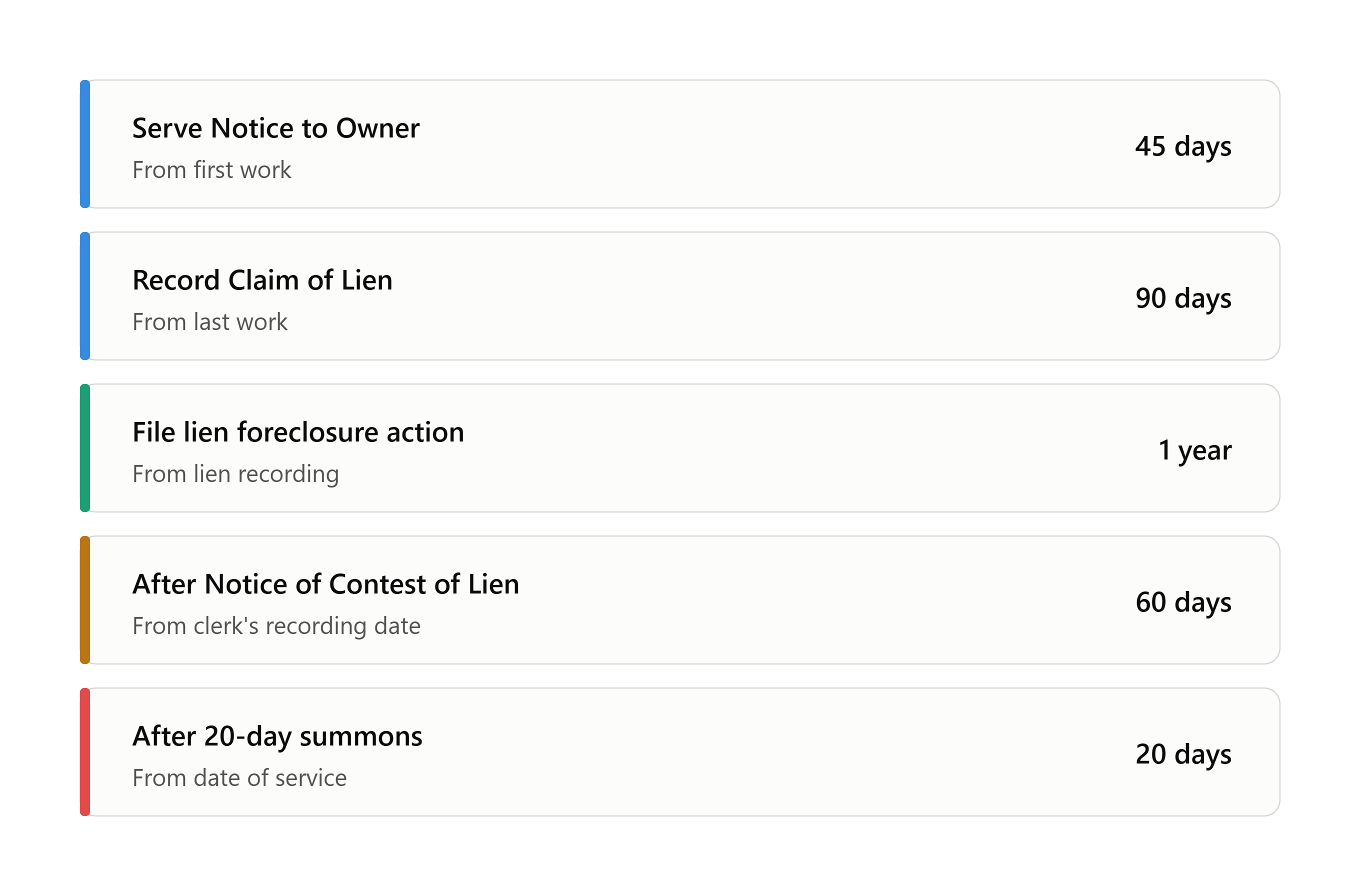
These deadlines may vary based on the claimant's role, project, and other circumstances. Always verify the deadline that applies to the specific claim.

Should You Sign a Satisfaction of Lien Before Payment?
No. A Satisfaction of Lien releases the recorded lien and should generally not be provided before the agreed payment has been received.
Once the satisfaction is recorded, the lien is removed from the property. If the payment later fails, the claimant may have surrendered its strongest source of leverage.
A claimant should not provide a satisfaction merely because the owner or contractor promises that payment will follow.
What Payment Method Is Safest Before Releasing a Lien?
Using a wire transfer is generally the safest option when the satisfaction must be released quickly and the parties do not fully trust one another.
Other payment methods may create reversal or collection risks:
- A personal or business check may bounce.
- A stop payment may be placed on a check.
- A cashier's check may be challenged in some circumstances.
- An ACH payment may potentially be reversed.
- A credit card payment may be disputed through a chargeback.
A wire transfer is generally harder to reverse once received and confirmed.
For larger or sensitive settlements, the parties may also use an attorney or another trusted third party to hold the satisfaction until the funds arrive in a trust or escrow account.
Common Mistakes After Recording a Florida Lien
- Assuming the lien automatically produces payment — Recording the lien creates security and leverage, but the claimant must still pursue collection or foreclosure.
- Waiting until the one-year deadline — The owner may shorten the deadline through a Notice of Contest or 20-day summons.
- Ignoring certified mail — Important lien-transfer documents and Notices of Contest may arrive by certified mail.
- Ignoring personal service — A process server may be delivering a lawsuit that requires action within 20 days.
- Treating three months as 90 days — Lien deadlines are calculated in calendar days.
- Waiting until day 90 to prepare the lien — Errors, missing information, weekends, holidays, and recording delays can cause the deadline to be missed.
- Giving a Satisfaction of Lien before payment — Releasing the lien before receiving secure funds removes collection leverage.
- Assuming a lien transfer is a defeat — A bond can provide a more reliable source of recovery than uncertain property equity.
- Hiring an unsolicited collector without research — Public lien records may attract questionable collection solicitations.
- Waiting without a documented strategy — Hope is not a collection plan. Every delay should have a clear business or legal reason.
Florida Post-Lien Action Checklist
Immediately after recording
- Save a certified copy of the recorded lien.
- Confirm the recording date.
- Calendar the one-year foreclosure deadline.
- Continue pursuing payment in writing.
- Monitor certified mail and legal service.
- Keep all project records organized.
During collection efforts
- Contact the customer regularly.
- Communicate with the owner when appropriate.
- Send a formal payment demand.
- Document partial-payment promises.
- Avoid releasing the lien before secure payment.
- Evaluate whether the business relationship justifies additional time.
If the lien is bonded off
- Review the Certificate of Transfer.
- Confirm the surety and bond amount.
- Preserve the bond documents.
- Recalculate all deadlines.
- Consult a construction attorney.
- Consider filing suit promptly.
If a deadline-shortening document arrives
- Identify whether it is a Notice of Contest or a 20-day summons.
- Determine the exact start date.
- Calendar the deadline immediately.
- Do not rely on settlement discussions to stop the clock.
- Contact legal counsel.
- File the required action before expiration.
Frequently Asked Questions
Does recording a Florida lien automatically get you paid?
No. Recording the lien creates an encumbrance against the property, but the claimant must continue pursuing payment and may need to file a foreclosure lawsuit.
How long does a Florida construction lien last?
A Florida construction lien generally lasts one year from the date it is recorded unless the enforcement period is shortened or a foreclosure action is timely filed.
How long do I have to record a Florida construction lien?
A Claim of Lien generally must be recorded within 90 calendar days after the claimant's last qualifying work or delivery of materials.
What happens when a Florida lien is bonded off?
The lien is transferred from the real property to cash or a surety bond. The claimant then pursues the transferred security rather than the property itself.
Is a bonded-off lien still valid?
The lien claim may continue against the transferred cash or bond, but the claimant must still comply with applicable enforcement deadlines.
What is the deadline after a Notice of Contest of Lien?
The claimant generally has 60 calendar days from the date the clerk records or stamps the notice to file a foreclosure action.
What is the deadline after a 20-day summons?
The claimant generally has 20 days from the date of service to file the required foreclosure counterclaim.
Should I provide a Satisfaction of Lien before I receive payment?
Generally, no. The satisfaction should be exchanged only after secure payment has been received or through a controlled escrow arrangement.
Can I sue for breach of contract and foreclose the lien?
Potentially, yes. Depending on the facts, a claimant may pursue lien foreclosure together with breach-of-contract and other legal claims.
A Florida Lien Is a Tool—You Still Have to Use It
Recording a construction lien gives contractors, subcontractors, and suppliers valuable leverage, but it is only the beginning of the collection process.
The strongest approach is to:
- Record the lien early enough to avoid a last-minute filing
- Actively pursue payment after recording
- Monitor the one-year foreclosure deadline
- Respond immediately to a Notice of Contest or 20-day summons
- Treat a lien transfer bond as a serious collection event
- Never release the lien before receiving secure payment
SunRay helps contractors, subcontractors, and suppliers prepare construction notices, monitor deadlines, preserve lien rights, and pursue payment throughout Florida and across the United States.
When a significant balance is at risk, a lien is bonded off, or a shortened enforcement deadline arrives, consult an experienced Florida construction attorney promptly.
FAQs: Fundamentals of Lien Laws

Ariela Wagner




.jpg)


